Research topics
Hyperuniformity
The properties of materials depend strongly on the spatial arrangement of their constituent elements—that is, on the nature of order and disorder in the system. Traditionally, crystals have been characterized as systems possessing long-range order, while random systems have been distinguished by their large density fluctuations.
Hyperuniformity is a concept that classifies point configurations according to the nature of their long-wavelength density fluctuations. Specifically, a hyperuniform system is one in which particle-number fluctuations at large length scales are more strongly suppressed than in ordinary random systems. This concept does not directly prescribe whether a structure is ordered or disordered; even periodic structures such as crystals can, in an appropriate sense, be classified as hyperuniform.
In particular, disordered hyperuniform structures—those lacking long-range order yet exhibiting suppressed density fluctuations—have attracted attention as a new framework for materials design beyond the conventional dichotomy of order and disorder. We theoretically investigate how such structures give rise to novel physical phenomena in quantum many-body systems and strongly correlated electron systems.
Open Quantum Many-Body Physics
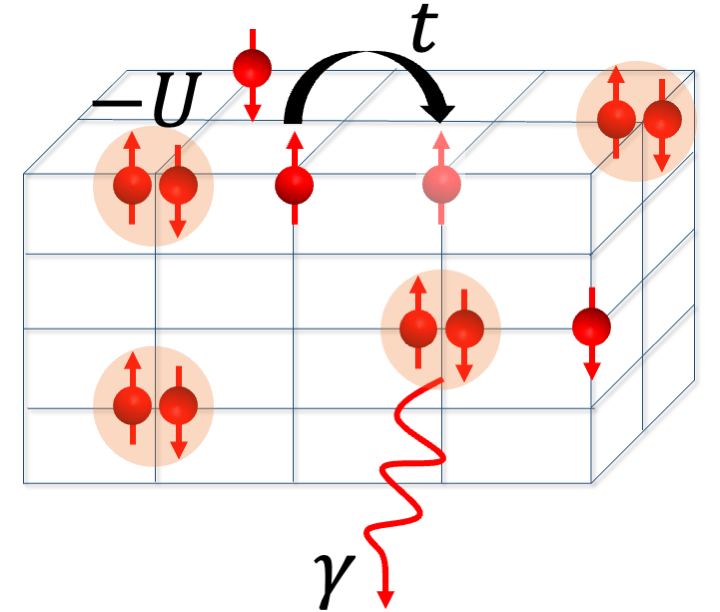
The development of experimental techniques using ultracold atoms has enabled not only flexible control of system parameters, but also control of dissipation and observation at the single-atom level. For example, in ytterbium (Yb) atomic systems, particle loss can be controlled using a technique known as photoassociation, and nonequilibrium phase transitions characteristic of open systems have been reported.
When extracting information from a quantum system through measurement, the observer effectively acts as an environment, and the measurement backaction induces non-negligible modifications to the quantum state. In particular, under the extreme spatial and temporal resolution achievable in ultracold atomic systems, the effects of measurement backaction become especially pronounced.
These developments go beyond the framework of isolated-system physics and open up opportunities to explore open quantum systems, in which interactions with the environment play a central role. As a result, this research direction has emerged as one of the recent hot topics, with broad relevance to quantum information science, condensed matter physics, and statistical mechanics.
Quasicrystal
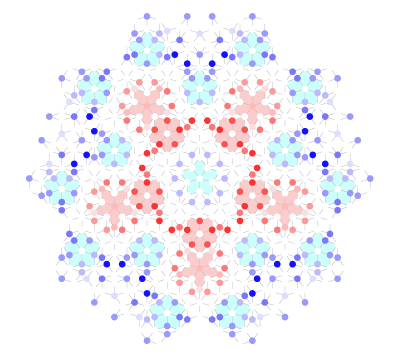
Quasicrystals, which are neither conventional crystals nor amorphous solids, were discovered in 1984 in rapidly quenched Al–Mn alloys, and since then they have been extensively studied. Although the atoms in these systems are arranged in an ordered manner, they lack translational periodicity. As a result, rotational symmetries forbidden in ordinary crystals—such as fivefold, eightfold, tenfold, and twelvefold symmetries—are allowed, and their intriguing quasiperiodic structures have attracted considerable mathematical interest.
In 2012, a quasicrystal containing the rare-earth element Yb, Au–Al–Yb, was synthesized. In this system, it has been suggested that Yb with an intermediate valence plays an essential role in the anomalous behavior observed in the specific heat and magnetic susceptibility at very low temperatures (quantum critical phenomena). Consequently, quasiperiodicity in strongly correlated electron systems has recently become one of the hot topics in condensed matter physics.
Kitaev Model and Quantum Spin Liquid
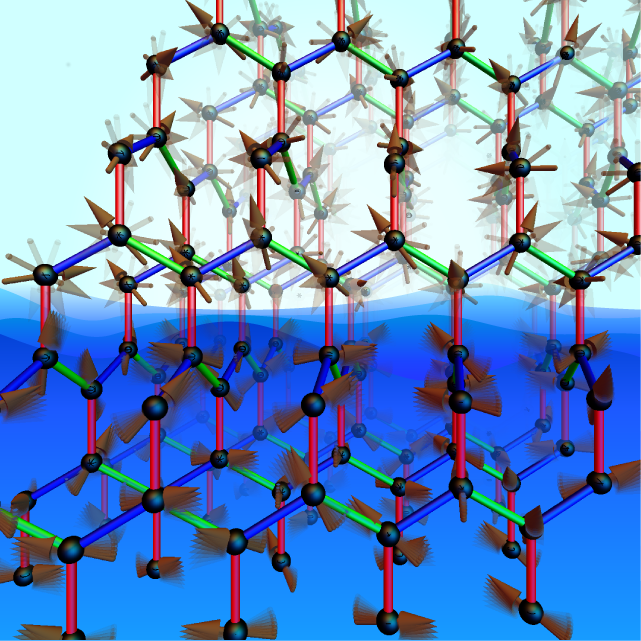
The origin of magnetism in magnetic materials lies in the electron spin, and understanding magnetic properties therefore requires a thorough understanding of the interactions between spins. Various theoretical models describing spin–spin interactions have been proposed and have successfully explained many magnetic phenomena. However, when spins are treated quantum mechanically, the resulting many-body models are often difficult to solve, and the study of magnetic systems with strong quantum fluctuations remains a frontier research topic.
The Kitaev model, introduced by A. Kitaev in 2006, is a quantum spin model that, despite its remarkable simplicity, has attracted significant attention not only in condensed matter physics but also in fields such as the foundations of statistical mechanics and quantum information science. From the perspective of solid-state physics, one of its most important features is that it hosts a quantum spin liquid as its ground state. The concept of a quantum spin liquid was originally proposed by P. W. Anderson in 1973, inspired by liquid helium, where strong quantum fluctuations prevent the system from freezing into an ordered state even at absolute zero temperature. Since then, quantum spin liquids have remained one of the central subjects in the study of magnetism.
Moreover, in iridium oxides with strong spin–orbit coupling, the Kitaev model is believed to capture essential aspects of their magnetic behavior. As such, research on the Kitaev model is expected to deepen our understanding of quantum spin liquids and magnetic materials with strong spin–orbit interactions.
Ultracold atomic systems
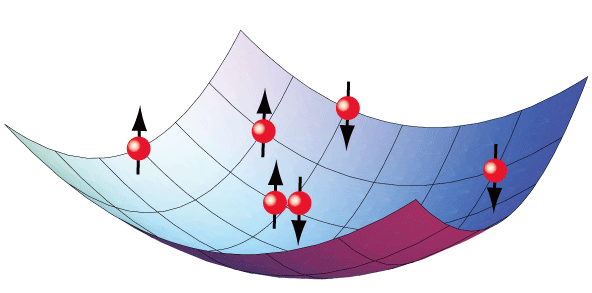
Ultracold atomic systems have recently emerged as one of the most rapidly advancing platforms in modern physics. In these systems, not only the strength and geometry of the confining potential and the quantum statistics of the particles (fermions or bosons), but also the interaction strength between atoms can be experimentally controlled with high precision. Indeed, the theoretically predicted BEC–BCS crossover in the superfluid state has been observed in ultracold potassium (K) atomic gases.
Furthermore, by using counter-propagating laser beams to create periodic potentials, optical lattice systems can be realized, in which ultracold atoms are confined in an artificial lattice. These systems attract considerable attention as ideal lattice models free from defects. Within such lattices, well-known quantum phases such as superfluid and Mott insulating states can be realized, and the possibility of supersolid phases has also been proposed. As a result, research on ultracold atomic systems continues to expand rapidly.
Strongly Correlated Electron Systems with orbital degrees of freedom
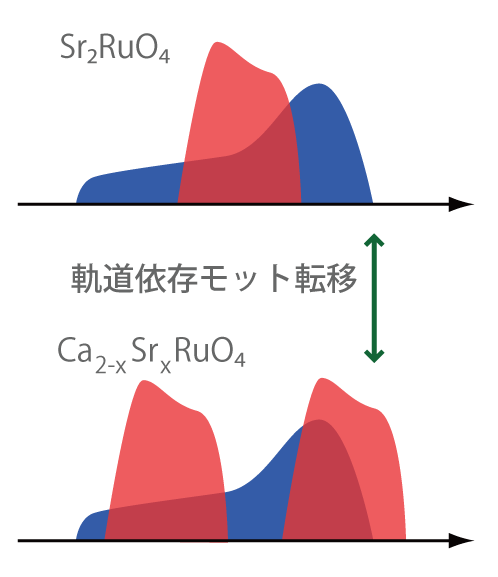
In d-electron systems, exemplified by transition-metal oxides, the spatial dependence of degenerate orbital wave functions gives rise to a variety of intriguing physical phenomena, including diverse types of magnetic order, orbital order, and superconductivity. A representative example is the ruthenate Sr2RuO4, in which superconductivity is realized. In this system, substitution of Sr with Ca suppresses superconductivity and leads to unusual orbital-dependent behavior.
For orbitals with quasi-one-dimensional character, the bandwidth decreases with Ca doping, and a metal–insulator transition occurs at a quantum critical point. In contrast, electrons in orbitals with quasi-two-dimensional character retain metallic behavior. These observations suggest the existence of an orbital-selective Mott transition, in which only a particular orbital among the degenerate ones undergoes localization, in contrast to a conventional metal–insulator transition.
Although the nature of this orbital-selective Mott transition has been extensively investigated experimentally, it remains theoretically nontrivial and contains a number of intriguing open questions. It has therefore attracted considerable attention as a novel phenomenon in strongly correlated electron systems with orbital degrees of freedom.